One Bright Space
← Back
Side project In build
Seabed dolphin listener
A €50 tube that sits on the sand off Marbella for a week, records everything it hears, then lets go of its bag of bricks and floats up on its own. No winch, no radio, nothing left on the seabed.
34 seconds: the drop, a week on the bottom, the burn wire parting, the rise on the lanyard, the surface, the bricks coming up. Rendered in Blender from the actual part dimensions.
How it works
01
Drop it
Four bricks in a mesh bag, the float a metre above on a short tether, 25 m of lanyard wound round its body like thread on a bobbin.
02
Listen for a week
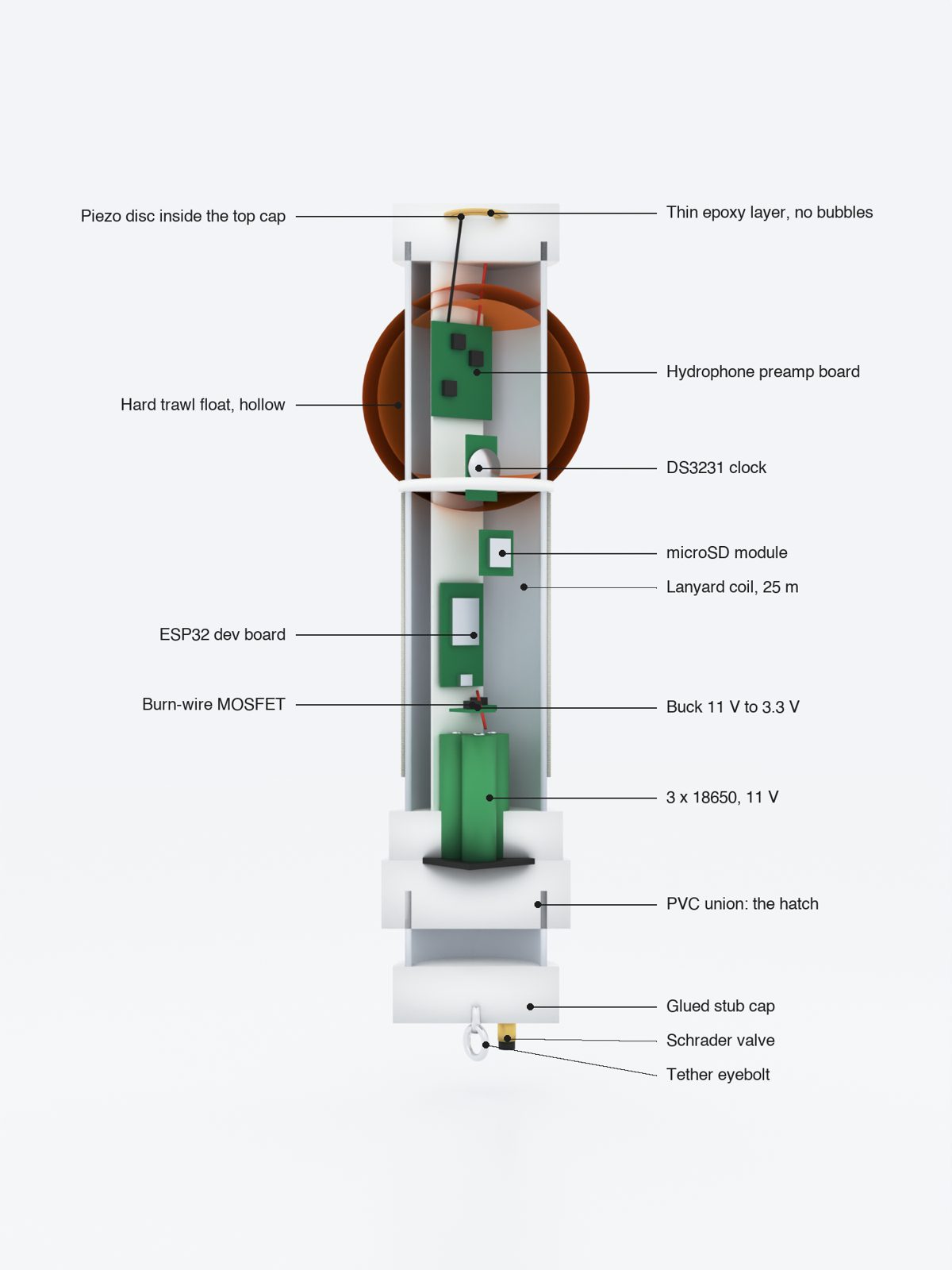
A piezo disc glued inside the top cap hears through the PVC. An ESP32 records 24 kHz audio to a 64 GB card on three 18650 cells.
03
Let go
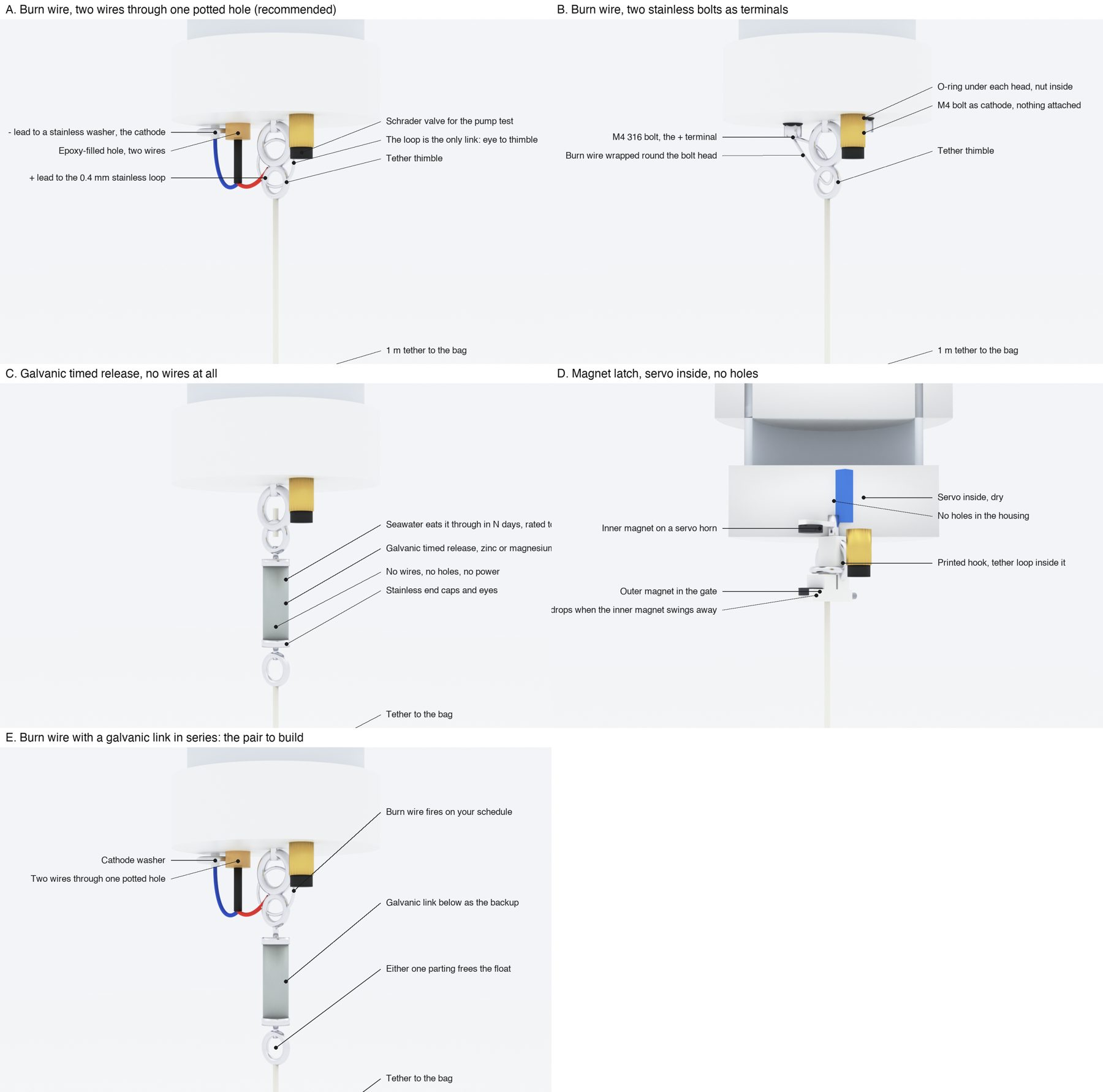
On day seven the ESP32 puts 11 V on a 0.4 mm stainless loop and seawater eats it in minutes. A galvanic link below it is the no-power backup.
04
Float up
The lanyard pays off the end of the coil, nothing turns, nothing can jam. The float waits at the surface on its line and you pull the bricks up by hand.
Inside the tube
The release, five ways
The numbers
| Depth | 10 to 30 m. 1 to 3 bar on the housing, nothing for an O-ring, a lot for a stitched seam. |
|---|---|
| Ballast | Four bricks, 10 kg dry, 4.8 kg wet. Bricks lose half their weight in water. Holds a 1 m/s current briefly. |
| Lanyard | 2 mm Dyneema, 1.3 × depth plus 5 m. About 400 kgf breaking for a 20 kg retrieval pull. |
| Power | About 55 mA average recording. Three 18650s give a week with margin. |
| Storage | 24 kHz 16-bit mono is 29 GB a week. A 64 GB card. |
| Cost | Under €50 in new parts on top of a homemade hydrophone and a bare ESP32. |
What it would hear off Marbella
- Bottlenose dolphin whistles out to about 500 m, clicks a few hundred metres
- Brown meagre drumming at dusk, cusk-eels at night, damselfish in summer
- Snapping shrimp around the clock, the crackle under everything
- Sea urchins grazing at dawn and dusk
- Boats and jet skis for kilometres, rain as broadband hiss
- Sperm whale clicks carried in from the deep Alborán on quiet nights
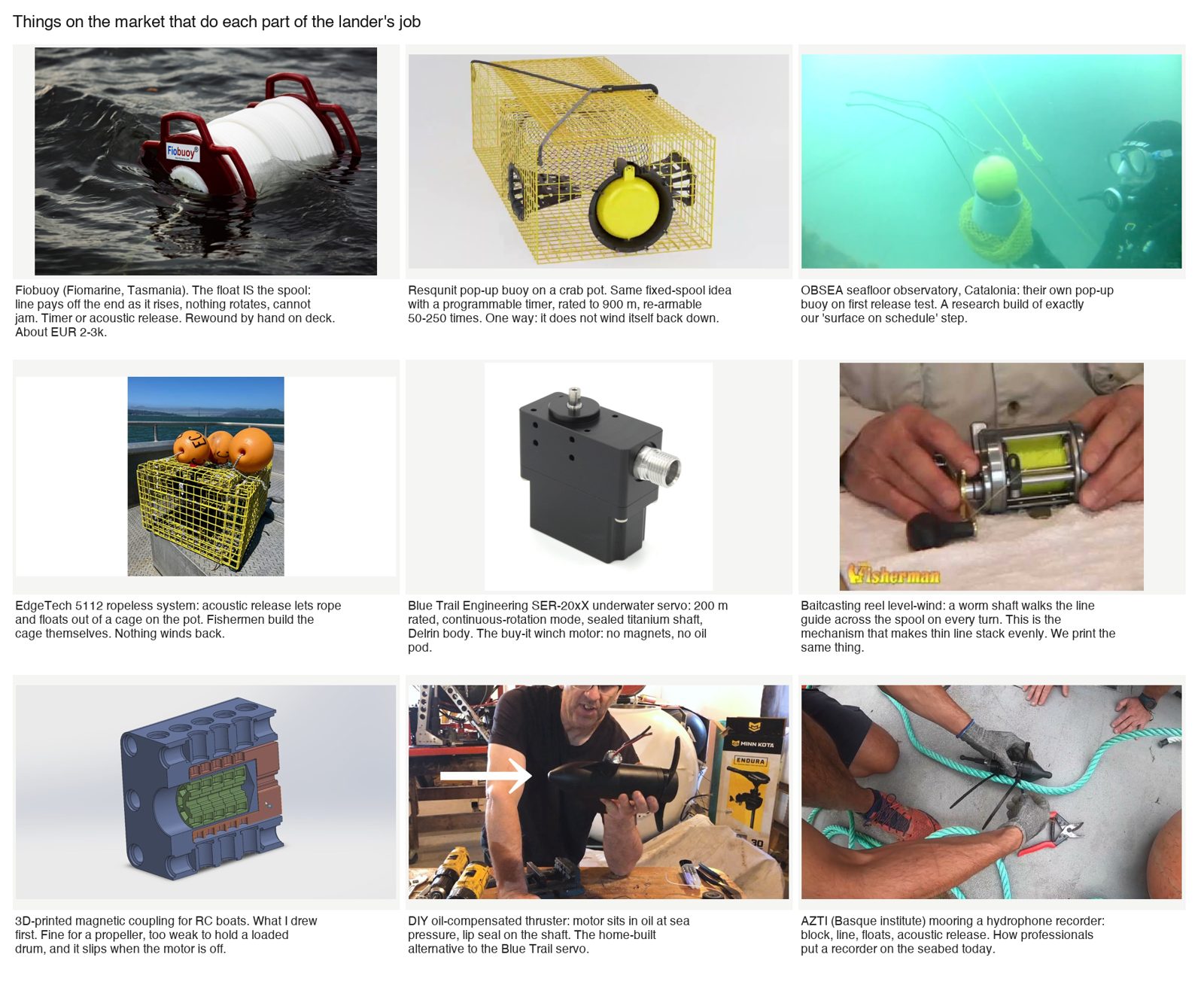
Nobody sells the "comes back down" part at hobby scale. Pop-up pot buoys only go up and are rewound by hand on deck, which is why this one is a one-shot too. The research instruments that winch themselves back cost tens of thousands.
What already exists